Why Use a Proxy or VPN? Key Differences, Benefits & Best Use Cases
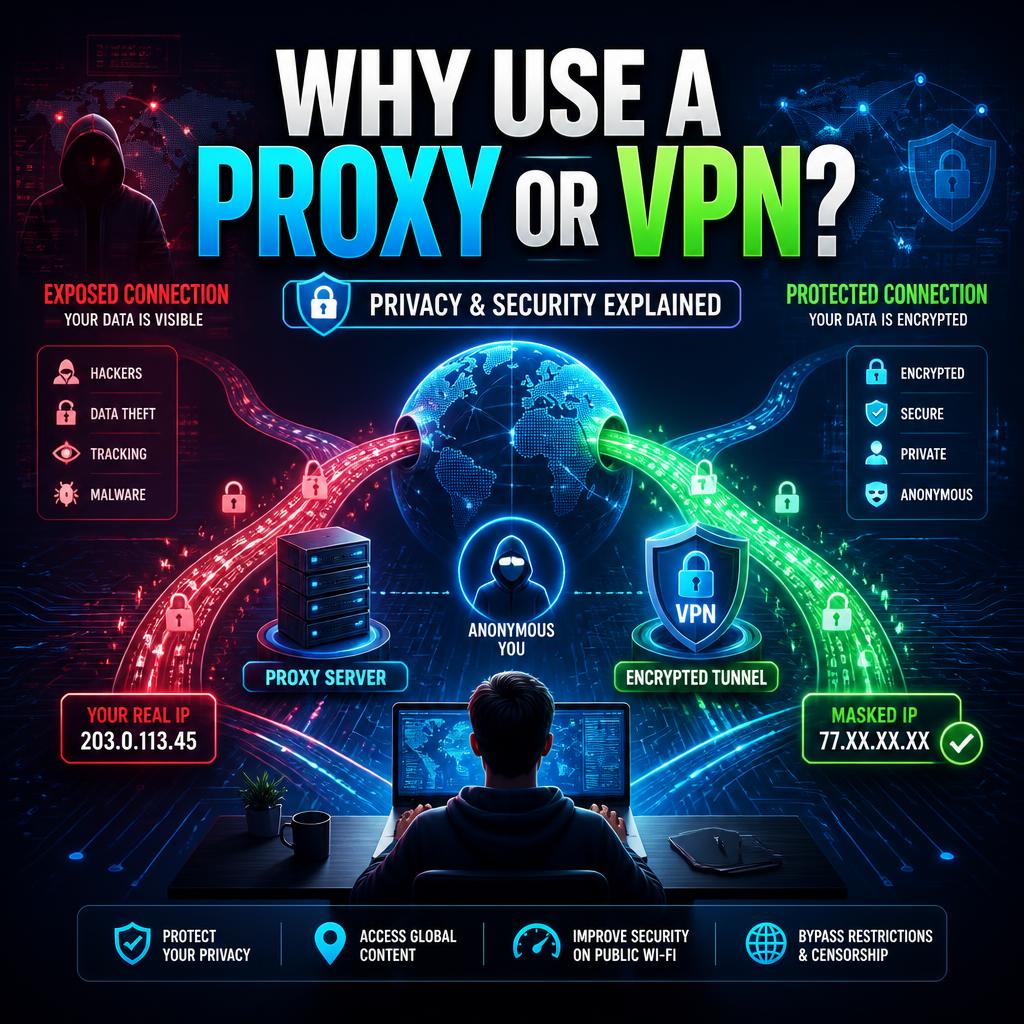
Why Use a Proxy or VPN?
Introduction
Privacy and security have become important considerations for anyone who spends time online. Whether you're browsing the web, working remotely, or using public Wi-Fi, protecting your internet connection helps reduce unnecessary risks. Two of the most common tools for improving online privacy are proxy servers and VPNs (Virtual Private Networks).
Although they are often mentioned together, proxies and VPNs serve different purposes. Understanding how each one works makes it easier to choose the right option for your specific needs.
Quick Answer
A proxy server acts as an intermediary between your device and the websites you visit, helping mask your IP address for specific applications or browsing sessions.
A VPN encrypts your internet connection and routes all network traffic through a secure server, providing stronger privacy and security across your entire device.
What Is a Proxy?
A proxy server receives your internet requests and forwards them to the destination website on your behalf. Instead of websites seeing your real IP address, they see the IP address of the proxy server.
Proxy servers are commonly used for:
- Hiding your IP address
- Managing network traffic
- Content filtering
- Web testing
- Business network management
- Research and development
What Is a VPN?
A Virtual Private Network (VPN) creates an encrypted tunnel between your device and a remote VPN server. This protects your internet traffic from being easily viewed by others, especially when using public or shared networks.
VPNs are commonly used for:
- Securing public Wi-Fi connections
- Protecting online privacy
- Encrypting internet traffic
- Remote work
- Business communications
- Reducing exposure of browsing activity
Proxy vs VPN: Key Differences
FeatureProxyVPN
IP Address Masking | Yes | Yes
Encrypts Traffic | Usually No | Yes
Device Protection | Selected apps | Entire device
Security Level | Basic | High
Speed | Often faster | May be slightly slower due to encryption
Best For | Testing, browsing, specific applications | Privacy, security, remote work
Benefits of Using a Proxy
- Helps hide your IP address.
- Useful for application-specific traffic.
- Can improve network management.
- Supports web development and testing.
- Often simple to configure.
- Commonly used by developers and businesses.
Benefits of Using a VPN
- Encrypts your internet connection.
- Improves privacy while browsing.
- Protects data on public Wi-Fi.
- Helps secure remote work connections.
- Reduces the risk of data interception.
- Protects all supported applications on your device.
When Should You Use a Proxy?
A proxy may be suitable when you need:
- Browser-based testing
- Web scraping where permitted
- Network administration
- Content filtering
- IP masking for specific applications
When Should You Use a VPN?
A VPN is generally the better choice when you want:
- Better online privacy
- Secure remote work
- Encrypted internet traffic
- Protection while traveling
- Safer browsing on public Wi-Fi
Best Practices
To get the most from either solution:
- Choose a reputable provider.
- Keep your software updated.
- Use strong passwords.
- Enable multi-factor authentication where available.
- Avoid sharing sensitive information over unsecured networks.
- Understand the privacy policy of your chosen service.
Common Mistakes to Avoid
- Assuming a proxy encrypts your internet traffic.
- Using free services without reviewing their privacy practices.
- Ignoring software updates.
- Forgetting to enable security features.
- Choosing a solution without considering your specific needs.
Which One Should You Choose?
If your priority is strong privacy and security, a VPN is usually the better option because it encrypts your internet traffic across your device.
If you only need IP masking or application-specific routing, a proxy server may be sufficient for certain tasks.
The right choice depends on your goals, the level of security you need, and how you use the internet.
Frequently Asked Questions
Is a proxy the same as a VPN?
No. Both can hide your IP address, but a VPN also encrypts your internet traffic, providing stronger privacy and security.
Does a VPN make browsing completely anonymous?
No. A VPN improves privacy by encrypting traffic and masking your IP address, but complete anonymity depends on many factors, including your online behavior and the services you use.
Is a proxy faster than a VPN?
A proxy can be faster because it usually does not encrypt traffic. A VPN may introduce a small performance overhead due to encryption.
Can I use a VPN on public Wi-Fi?
Yes. VPNs are commonly used to protect internet traffic when connected to public or shared Wi-Fi networks.
Which option is better for security?
A VPN generally provides stronger security because it encrypts your internet connection, while most standard proxies do not.
Conclusion
Both proxies and VPNs have legitimate uses, but they solve different problems. A proxy is useful for routing traffic and masking your IP address in specific situations, while a VPN offers broader protection by encrypting your internet connection. Understanding the strengths of each tool helps you choose the option that best fits your privacy, security, and networking needs.
Related Posts
How to Secure Your Online Accounts in 2025
Why Account Security Matters In today’s digital world, online accounts contain personal information, financial data, and communication history. Whether you manage social media accounts, business accounts, or personal profiles, keeping them secure is essential. A strong and secure account protects you from hacking, phishing, data loss, and unauthorized access.
How to Use Reddit Safely Without Getting Banned
Learn how to use Reddit safely and avoid account bans. Follow simple rules and best practices to keep your account secure.
How to Check if Your Email Has Been Hacked (Step-by-Step Guide 2026)
Worried your email might be hacked? Learn how to check if your email has been compromised and what to do immediately to secure your account in 2026.